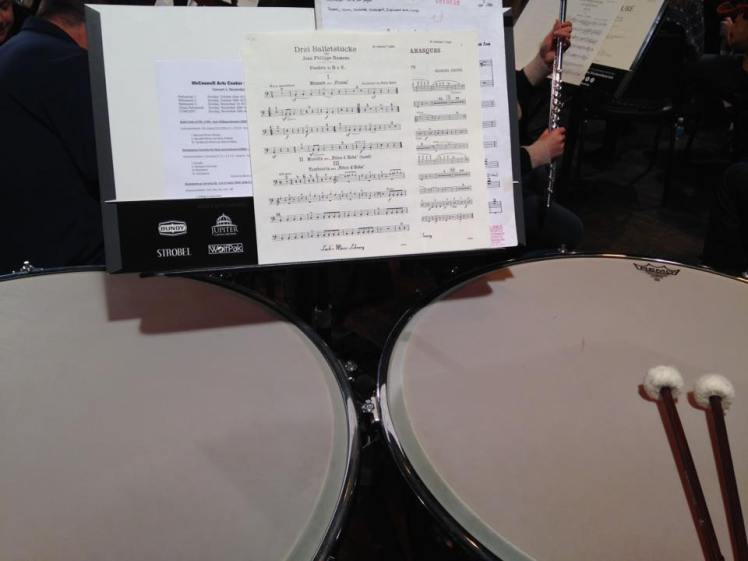
I had the privilege of sharing my last performance in Columbus, OH with the musicians of the McConnell Arts Center Chamber Orchestra on November 20th, 2016. The group is conducted by my friend and colleague, Dr. Antoine Clark. The program included works by Rameau, Bach, Foss, and by far on of my favorite works, Pavane, Op. 50 by Gabriel Faure. For this performance I played Timpani and I came across some very challenging tuning changes on drums with no gauges, off heads, and stuck pedals. What do you do in this situation as a freelance percussionist?
For most musicians when they graduate from their School of Music, they take their instrument with them. They live with it, care for it, play it everyday. I do not know many freelance percussionists that own Timpani. For a set of four you are looking at thousands of dollars, a giant vehicle to move them, and house to store them. My biggest challenge in these situations are I have a part I need to prepare with no instrument to practice on. What do you do?
This would not typically be a problem for me as I could practice on pillows and use a tuner to check my pitches, but then I saw the second movement of the Lukas Foss Renaissance Concerto for Flute and Orchestra and knew I was in for some work. Melodic passages spread across multiple drums with expectations that the instrument you would be using can accommodate this, and the performer had the necessary skill to achieve the desired effect.
I knew I had to get to work immediately but how do you practice a melodic timpani passage requiring you to move the pedals as you perform without having the drums? The best solution in this situation is to sing the part to the best of your ability. And of course always always always find multiple recordings if possible. Check yourself with a tuner or piano. Record yourself singing and check your tuning again while visualizing your pedal/tuning plan. Make sure you are intimately familiar with the tonal center and make a plan for what pitch will be played on each drum. However, you cannot stop at just singing the pitches, I highly suggest singing articulations, slurs, and any other musical adjective needed to perform the passage at its highest potential. This will help you discover mallet choices, dampening, dynamics, pedal speed, and make you more comfortable with the passage.
Another tip in this situation is to arrive to rehearsals as early as you can to practice and to clear the heads or provide other maintenance. In this situation, we had enough rehearsals for me to clear one drum at each service and still practice tuning passages.
Good luck out there and don’t forget, listen to recordings, sing your parts, make a plan, and visualize the execution in performance!
 Kevin Estes Music